
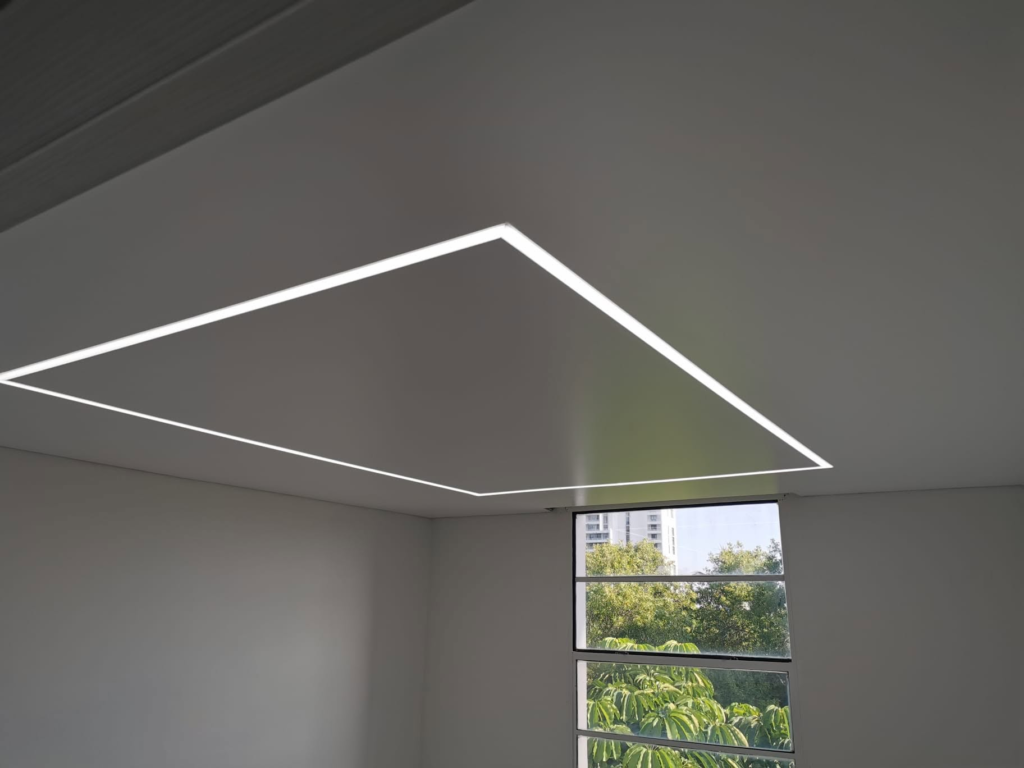
Stretch ceiling vs conventional ceiling comes down to this: a conventional ceiling is built in place over several days, out of many materials, by hand, while a stretch ceiling is a single PVC membrane tensioned into a perimeter track, installed in one day, with a finish that is flawless by design rather than by effort.
Key takeaways
- Less resources. One membrane and a track instead of boards, compound, tape, primer and paint.
- Less time. Most rooms are finished in a single day instead of several.
- Less work. A perfectly smooth surface comes from the tension, not from hours of sanding.
- Cleaner job site. No drywall dust, no repainting, furniture mostly stays put.
If you are choosing between a stretch ceiling and a traditional drywall or plaster ceiling, the honest difference is not just how they look when finished. It is how much disruption, labor and uncertainty stands between you and that finish.
In a stretch ceiling vs conventional ceiling comparison, both can give you a clean, flat white ceiling. Only one of them gets there in a day, without dust sheets over every surface in the room, and without depending on how good a hand the plasterer had that week.
1. Less resources
Conventional ceilings require a variety of tools and materials to reach an excellent result: framing, drywall boards, screws, tape, joint compound, sanding equipment, primer, and at least two coats of paint. Every one of those is a cost line, a delivery, and a thing that can be done badly.
A stretch ceiling reduces that to two core components: a perimeter track and a single PVC membrane cut to the dimensions of your room. The membrane arrives finished in the color and texture you chose. There is nothing to mix, nothing to dry, and nothing to repaint later.
Core components
A perimeter track and one pre-finished membrane. That’s the system.
Day of install
Most standard rooms are measured, tensioned and finished the same day.
Sanding & repainting
No joint compound, no dust, no second visit for a touch-up coat.
2. Less time
In any stretch ceiling vs conventional ceiling comparison, time is the biggest gap. Stretch ceilings can be installed in just one day. Conventional ceilings sometimes require several days, because the process is sequential: you cannot tape until the boards are up, you cannot sand until the compound has cured, and you cannot paint until the sanding is done and the dust has settled.
Each of those waiting periods is a day your kitchen, salon, clinic or office is not usable. For a commercial space, that downtime is usually the largest hidden cost of a conventional ceiling, larger than the materials themselves.
The membrane is installed in the state it will stay in. There is no curing, no drying, and no finishing stage after the installers leave.
3. Less work
To get the same quality of result from a conventional ceiling that a stretch PVC membrane gives you by default takes significant skill and effort. Think about what it actually takes to make a ceiling perfectly smooth: every seam feathered, every screw head filled, every imperfection caught under raking light and sanded back by hand, overhead, for hours.
Even then, the outcome depends on the individual craftsman. A stretch ceiling is tensioned flat by physics. The result is consistent, which is why the finish is always satisfying, and why it looks identical in the corner of the room as it does in the center.
Stretch ceiling vs conventional ceiling: side by side
| Factor | Stretch ceiling | Conventional ceiling |
|---|---|---|
| Installation time | Typically one day | Several days, with drying stages |
| Materials needed | Track + membrane | Framing, board, tape, compound, primer, paint |
| Dust & mess | Virtually none | Heavy sanding dust throughout the space |
| Finish consistency | Flawless by tension | Depends on the installer’s skill |
| Moisture resistance | Waterproof; can hold a leak | Stains, swells and must be replaced |
| Access to pipes & wiring | Removable and refittable | Requires cutting and patching |
| Finish options | Matte, satin, gloss, printed, backlit | Paint sheen only |
| Maintenance | Wipe clean; no repainting | Repaint every few years |
| Cracking | Unaffected by settling | Hairline cracks over time |
When does a conventional ceiling still make sense?
Honestly: when the existing ceiling is already flat, sound and recently painted, and you only need a color change. Patch-and-paint will be cheaper than a new system. Conventional construction also remains the choice where a ceiling must be structural or carry significant weight.
In the stretch ceiling vs conventional ceiling decision, everything else tips one way: renovations, uneven or cracked surfaces, rooms with pipework overhead, bathrooms and kitchens, and any commercial space where downtime costs money all favor the stretch ceiling on nearly every factor in the table above.
What about height, lighting and durability?
Ceiling height
A stretch ceiling drops the surface by roughly 1–2 inches, slightly more where recessed lighting is integrated. In most rooms the loss is not noticeable.
Lighting
Spotlights, chandeliers, linear profiles and fully backlit translucent panels can all be integrated. Positions are planned before installation, since reinforcing rings are fitted into the membrane.
Durability
A quality PVC membrane typically carries a manufacturer warranty of 10–15 years and does not crack, flake or yellow. It also resists mold, which is why it performs well in bathrooms and kitchens.
Frequently asked questions
Is a stretch ceiling cheaper than drywall?
Material cost per square foot is often comparable, but the total installed cost is usually lower because labor is a single day and there is no painting stage, no cleanup of sanding dust, and no return visit. For commercial spaces, the reduced downtime is typically the bigger saving.
How long does a stretch ceiling take to install?
Most standard rooms are completed in one day. The membrane is manufactured to your measurements in advance, so on-site work is limited to fitting the perimeter track, heating and tensioning the membrane, and finishing the edges.
Can a stretch ceiling be installed over an existing ceiling?
Yes. That is one of its main advantages. The membrane is tensioned on a track fixed to the walls, so the condition of the surface above it (cracked plaster, old tiles, exposed pipework) does not matter and nothing needs to be torn out.
What happens if there is a leak from above?
A PVC membrane is waterproof and will hold a substantial volume of water, protecting the room below. An installer drains it and refits the same membrane. A drywall ceiling in the same situation stains, sags and has to be replaced.
How do you clean a stretch ceiling?
Wipe it with a soft cloth and mild soapy water. It never needs repainting, which removes the recurring maintenance cost of a conventional painted ceiling.
Can a stretch ceiling be removed later?
Yes. It can be untensioned to reach wiring or plumbing and then refitted, which is far less invasive than cutting and patching drywall.